Materials & interiors
Cisco Home Upholstery Choices: Natural Fibers, Durability, and Care
A sofa is a material decision disguised as a piece of furniture. Its fabric meets the daily weather of a household—sunlight, spilled coffee, a dog’s damp nose, the small negotiations of people settling in for the evening. To choose thoughtfully, look beyond a fabric’s name. Fiber, weave, backing, finish, frame, and care all help determine how a sofa feels and how gracefully it ages.
A practical guide to evaluating Cisco Home upholstery, asking useful questions, and matching natural-fiber options to the rhythms of your home.
Start with the whole construction, not the swatch
Fabric samples encourage a certain kind of optimism. They are small, immaculate, and free of the conditions that make upholstery consequential: a broad seat pressed into service every day, the arm that catches afternoon sun, the cushion where someone always sits to tie a shoe. A swatch is still useful, but it is only one part of the inquiry. Ask what the fabric is made of, how it is woven, whether it has a backing or finish, and what care it requires. Then consider the seat beneath it and the frame holding everything in place.
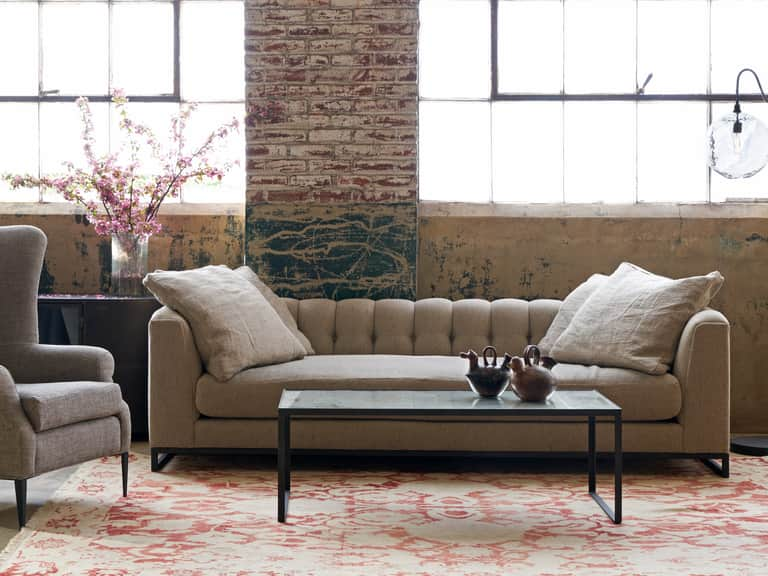
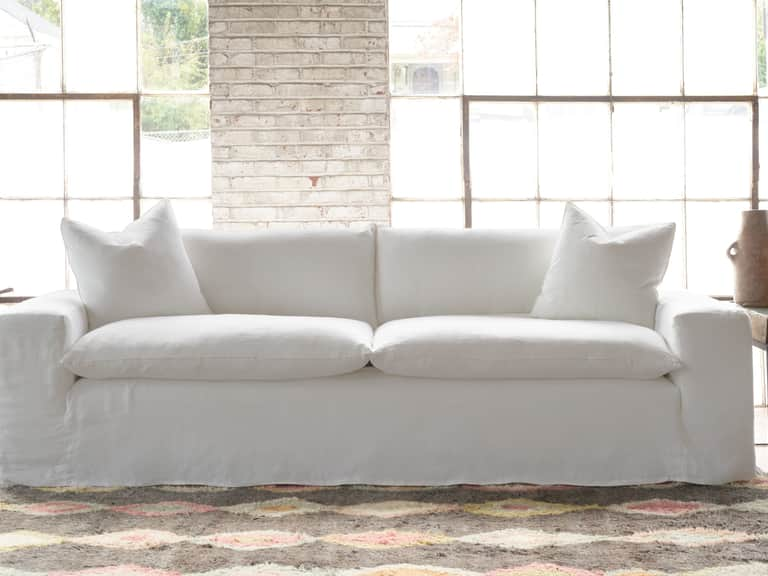
That broader view is especially relevant when evaluating a customizable sofa. Cisco Home’s available specifications, for example, describe the Cisco Home Richard Sofa as having an FSC-certified hardwood frame, webbing support, a tufted back, and a bench seat. The Cisco Home Austin Sofa is described with an FSC-certified wood frame and webbing support, and is available upholstered or slipcovered. Those details are informative, but they do not identify the precise fiber composition, weave, or finish of every upholstery selection. That information should be confirmed for the particular fabric being considered.
This distinction matters. A manufacturer’s description of a sofa’s frame or environmental options is not a substitute for a fabric specification. Nor does a natural-sounding fabric name, by itself, establish that the material is organic, untreated, or low-emission. The useful question is not simply “Is this a green sofa?” It is: What is each component, what evidence supports the claim, and will the construction suit the way the sofa will be used?
What “natural fiber” can—and cannot—tell you
Natural upholstery fibers include materials such as cotton, linen, wool, and some plant-based fibers. Each has its own character, and none can be reduced to a universal promise of durability or environmental virtue. Performance depends on the individual yarn, fabric construction, finishing, and how the textile is maintained. A natural fiber may be a good fit for one household and a frustrating one for another.
Cotton is familiar, versatile, and available in many weaves and weights. Its hand can range from crisp to soft, and its appearance varies according to yarn and construction. But “cotton” alone does not reveal whether a particular upholstery fabric will resist abrasion, fade in direct light, or release a stain easily. Ask whether it is blended with other fibers, whether it has a backing or protective finish, and what the care instructions say. If organic sourcing is important, ask for a product-specific certification or documentation rather than relying on the fiber name.
Linen, made from flax, often has a relaxed surface and a visible texture that lends a room a less formal air. Its natural creasing is part of its appeal to some people and an ongoing irritation to others. Linen upholstery can vary substantially in weight and weave. A finely textured decorative fabric and a robust upholstery-weight textile should not be presumed to perform alike simply because both contain linen. Ask about the intended application and any blend, lining, or finish that changes its behavior.
Wool can bring resilience and a distinctive tactile quality, but it is less common in some sofa collections and should be assessed as a specific fabric, not an abstract material category. Its blends, weave density, and cleaning requirements matter. For any fiber, the practical test is to obtain the exact specification and care guidance before ordering—not to infer performance from reputation.
Synthetic and blended fabrics deserve equally careful consideration. A synthetic fiber is not automatically unsuitable, and a natural fiber is not automatically the more durable or lower-impact choice. Blends can be designed to balance appearance, resilience, and maintenance. The responsible comparison considers the full life of the textile: how it is made, how long it is likely to remain useful under the intended conditions, whether it can be repaired or cleaned, and what happens when it is eventually discarded.
Ask for the particulars of the exact fabric
When a sofa is customizable, the selected upholstery is not a decorative afterthought. It is a specification that should be documented. A showroom sample may be labeled with a collection or color name, but a useful decision requires more. Request the complete fiber breakdown, the fabric’s country of manufacture if available, and information about any backing, stain treatment, dyeing, or other finish. Ask whether the sample represents the current production fabric and whether the care instructions apply to that precise selection.
It can also help to ask how the fabric’s performance has been assessed. Upholstery textiles may be tested for abrasion, colorfastness, or other properties, but a test result is not a guarantee that a fabric will remain pristine in every home. It is a comparative clue, and its meaning depends on the test method and the way the sofa will be used. Ask for the method and the result, rather than treating a single number as a complete verdict.
- What are the exact fiber percentages, including any lining or backing?
- Is the textile dyed, coated, stain-treated, or otherwise finished? If so, what is used?
- What cleaning methods are allowed, and which common products should be avoided?
- Is the fabric recommended for frequent, everyday seating, or primarily for lighter use?
- Are performance claims supported by test information or a written specification?
- Does a certification apply to this fabric, the finished sofa, or a particular material within it?
- Can the upholstery be replaced or repaired, and are replacement materials likely to remain available?
These questions are not an attempt to turn a purchase into an audit. They are a way to make a vague promise legible. “Natural,” “eco-friendly,” and “non-toxic” are broad descriptions; each can refer to different things. One might concern the source of a fiber, another the chemical treatment of a finish, and another the manufacturing process. The more specific the claim, the easier it is to understand what it does—and does not—mean.
Durability is a household question
The durability of upholstery is not decided by a laboratory alone. It is also a story about who lives with the sofa. A formal sitting room used occasionally has different demands from a family room where children climb over the back, pets nap on the cushions, and dinner sometimes arrives in bowls. Before choosing a fabric, describe the actual circumstances of use to the retailer. “We have a cat” is more helpful than “We want something durable”; “the sofa sits in direct afternoon sun” is more useful still.
Pets bring claws, fur, oils, and the occasional accident. A textured or open-weave textile may catch claws or collect hair, while a smooth surface may be easier to wipe but show marks in a different way. No fabric is genuinely pet-proof. Ask for a sample to take home and observe it under your own lighting; if possible, ask how the manufacturer recommends handling hair, stains, and snagging. Do not test a showroom sample with a pet or cleaning product unless the retailer explicitly permits it.
Children and busy households make cleanability a central concern. Removable cushion covers can be helpful only if the maker confirms that they are intended to be removed and explains how to clean them. A fabric that looks washable is not necessarily machine washable. Shrinkage, color change, and distortion can make a well-intentioned home wash an expensive experiment. Confirm whether professional cleaning is required and whether the instructions differ between the body fabric and loose cushions.
Sunlight is an unhurried but persistent force. Strong direct exposure can fade upholstery, and the degree of change varies by fiber, dye, finish, and location. If the sofa must sit beside a bright window, ask about lightfastness information and consider using curtains or blinds during the strongest sun. Rotating cushions, when their construction permits it, may help distribute wear and fading more evenly. The aim is not to keep a living room in perpetual shade, but to understand the conditions the fabric will encounter.
Daily seating patterns matter, too. A bench seat presents a continuous surface and may create a different visual rhythm from individual cushions. Tufting and cushion construction influence appearance and upkeep; they can also affect how wear is distributed. The Richard Sofa, for instance, is specified with a tufted back and a bench seat, while the Austin Sofa has two seat toppers with core and two loose back cushions. Such details do not establish a fabric’s durability, but they are part of the maintenance picture: ask how cushions should be arranged, whether they can be turned, and what ordinary settling or wrinkling to expect.
Frames and support are part of sustainability
Upholstery occupies the eye, but a sofa’s useful life depends on more than its visible cloth. A sturdy frame, appropriate suspension, sound joinery, and cushions that can be maintained all contribute to whether a piece stays in use. Replacing a sofa because its support has failed, while its fabric remains serviceable, is an especially dispiriting form of waste. Conversely, a durable frame does not make a poorly matched upholstery choice immune to stains or fading.
The Cisco Home product specifications available for the Richard and Austin sofas list FSC-certified wood in their frames and webbing support. FSC certification relates to responsible forest management and chain-of-custody requirements; it does not, on its own, certify every material in the finished sofa or settle every question about environmental impact. It is one useful piece of information within a larger assessment. Ask what the certification covers, and whether documentation is available for the model and configuration you are ordering.
It is also reasonable to ask about repair. Can a local upholsterer work on the frame? Are cushions replaceable? Can the manufacturer provide fabric yardage or replacement components later? A sofa designed to be maintained is often more practical than one whose only path to renewal is complete replacement. These questions may not have a simple answer, especially with custom orders, but they help reveal how repairable the object is in real life.
Slipcovers, upholstery, and the question of upkeep
A slipcover can change the relationship between a sofa and its household. It may be removable, replaceable, or simply easier to handle than fixed upholstery, depending on the design. That does not mean every slipcover can be tossed into a washing machine. Fabric weight, tailoring, closures, and the maker’s care instructions still govern what is possible. Ask whether the cover is designed to be laundered, professionally cleaned, or removed only for reupholstery.
The Austin Sofa is described as available either upholstered or slipcovered, with a low-maintenance slipcover option. The phrase is promising but should be clarified in practical terms: What does “low-maintenance” mean for the chosen fabric? Can the cover be removed? How should a spill be treated? Is there a recommended cleaner? For the Richard Sofa, the listed specifications say it is upholstered and not slipcovered. The distinction may influence a buyer’s daily routine as much as the silhouette does.
For either construction, request written care instructions before the order is finalized. Keep them with the purchase paperwork. Follow the maker’s guidance on vacuuming, brushing, blotting, and professional cleaning. When a spill occurs, act promptly but gently; rubbing can push a stain deeper or distort the fabric. Avoid applying a household cleaner to a conspicuous area without checking that it is approved for the textile. An attractive shortcut can produce a permanent ring or discoloration.
A realistic routine for caring for upholstery
Good care is rarely dramatic. It is a collection of modest habits: keeping food and drink from becoming a permanent feature of the sofa, using a soft upholstery attachment when vacuuming, and shifting cushions if the design allows. Dust and grit can act like fine abrasives as people sit and move. Regular, gentle cleaning helps prevent that accumulation from becoming part of the fabric’s texture.
- Vacuum lightly: Use a suitable upholstery attachment and avoid pulling at seams or fringes.
- Rotate or reposition cushions: Do so only when their shape and construction permit it, and follow the maker’s instructions.
- Blot spills: Use a clean, absorbent cloth and work from the outside of the spill toward the center. Do not scrub unless instructed.
- Protect from strong sun: Use window coverings or adjust the sofa’s position when practical.
- Use approved cleaning methods: Check the exact fabric guidance before applying water, solvents, or a commercial stain remover.
- Keep records: Save the fabric name, fiber content, order details, warranty, and care sheet for future repairs or cleaning.
Care should be matched to the particular textile. Some upholstery is suitable for water-based methods; some requires solvent-based professional cleaning; some should be cleaned only by a specialist. A generic internet tip may be appropriate for one fabric and harmful to another. When in doubt, ask the retailer or manufacturer before treating a stain. The quiet discipline of a phone call is often preferable to the louder drama of a bleached patch.
How to evaluate environmental claims without being overwhelmed
Eco-friendly furniture is not a single material category. It is a set of questions about sourcing, manufacturing, durability, health, and end of life. A natural fiber may be renewable, but its environmental profile also depends on cultivation, processing, transport, dyeing, and how long the finished fabric remains in use. A synthetic blend may use fossil-derived materials, yet if it performs well for many years it may have a different practical footprint than a fragile alternative replaced quickly. There is no honest shortcut that turns one label into a complete life-cycle assessment.
Certifications can make particular claims more checkable, but read their scope. A textile certification may address fiber content or processing; a wood certification may address forest sourcing; an indoor-air program may assess emissions. These are different concerns. A certification associated with one component should not be read as approval of every part of the sofa. Ask for the name of the standard, which component it applies to, and whether the documentation is current.
Transparency is a useful signal in its own right. A company that can clearly identify a fabric’s composition, explain its finishes, provide care instructions, and distinguish verified facts from general marketing language gives the customer something solid to evaluate. If an answer is incomplete, that is not necessarily proof of a problem; it is a reason to pause and ask for clarification before committing to a custom order.
A short pre-order checklist
Before choosing upholstery for a Cisco Home sofa—or any customized seating—take a moment to put the decision in writing. It can be as simple as a note on your phone, but it should capture the points most likely to matter after delivery.
- Record the exact fabric collection, color, and fiber percentages.
- Confirm any backing, stain treatment, dye, or other finish relevant to your concerns.
- Obtain the care instructions for the specific fabric and construction.
- Describe pets, children, regular guests, sunlight, and the room’s everyday use.
- Ask about repair options, replacement covers, cushion servicing, and future fabric availability.
- Clarify which environmental or safety claims have documentation and what each applies to.
- Keep a sample at home long enough to see it in morning, afternoon, and evening light.
It is worth remembering that upholstery changes in use. A soft fabric may relax; a cushion may settle; natural textures may show the marks of ordinary living. Ask what kind of change is expected and what would count as a problem covered by warranty. A sofa is not a sealed object behind glass. It is an instrument of everyday life, and the best choice is often the one whose likely changes you can accept.
The useful answer is the specific one
The appeal of natural-fiber upholstery is understandable: texture, a connection to familiar materials, and the possibility of making more deliberate choices about what enters the home. But naturalness alone cannot tell you whether a sofa will suit your family, whether a fabric can be cleaned at home, or whether a sustainability claim covers the entire piece. Those answers emerge from the particulars.
Look at the fiber, but also the weave and finish. Consider the frame and support alongside the cover. Match care demands to the household you have, rather than the unusually tidy household a showroom implies. With Cisco Home’s customizable designs, ask for the specification of the precise upholstery selection and verify that care and sourcing information applies to the sofa configuration in front of you. Then make the decision with both the room and its future in mind.
A good sofa does not need to remain untouched to be successful. It needs to remain comfortable, serviceable, and welcome as a home gathers the small evidence of living. The most sustainable upholstery choice is rarely a slogan. It is a fabric whose qualities are understood, whose maintenance is manageable, and whose construction gives it a reasonable chance of staying in the room for a long time.